Why human SDRs still beat AI — and how Whistle scaled to 350 clients
AI gets you 80% of the way immediately, 90% after hours of work, and never the last 10%. That's why, for B2B outbound, David Zeff still bets on people: 73% of the meetings Whistle books come from the phone, not automation. The agencies winning right now aren't removing humans from the loop — they use AI to make human reps faster, and keep the relationship where the money actually is.
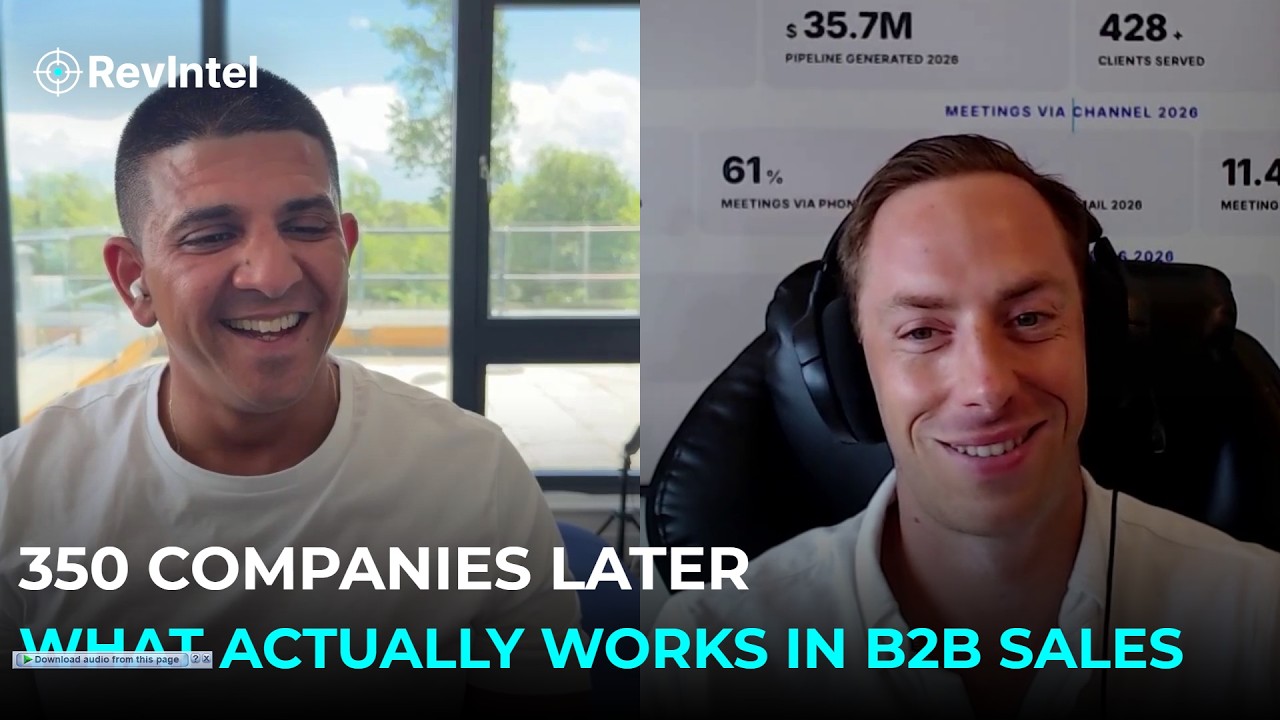
Watch the full episode · 61 min
Key takeaways
Each one a claim that stands on its own.
- "AI will get you 80% of what you want immediately, 90% after hours, and never 100%." — David Zeff
- 73% of the meetings Whistle books come from the phone — the final frontier of outbound.
- Before you hire any SDR team, get your ICP right: to find the one yes, you have to find ninety-nine no's.
- Only pay commission once a client has stayed three months — it stops reps signing bad-fit clients.
- Before EOS it was "controlled chaos" — sign, churn, sign, churn. Systems ended the cycle.
- A CEO’s real job is to become the least important person day-to-day: build castles or fight dragons.
Chapters
Each heading is the question the guest answers — and a query a buyer types.
- 00:55Who is David Zeff, and the agency he "built by mistake"?
- 02:37From Sydney fitness and finance to a global agency in Tel Aviv
- 13:13Three exits — and why he restarted at the bottom as an SDR
- 22:17The first hire that mattered, and the stress of five clients
- 31:32Systemising with EOS: from "controlled chaos" to scale
- 37:04What a bad-fit client looks like at 300 clients
- 41:35Why he bets on humans when the market bets on AI
- 47:00Deploying SDRs in 10 days: what others get wrong in six months
- 57:42The one thing to get right before you outsource: your ICP
Full transcript
In the page’s HTML — the part search engines and AI answer engines read.
Ladies and gentlemen, today I have a very interesting guest — David Zeff. What makes this episode different is David doesn't run one sales pipeline. He runs hundreds across 300-plus clients, and sees what works and fails across every industry every quarter. That cross-company pattern recognition is something no single VP of sales can match. You went from reporting on M&A deals to owning a gym franchise to running a hundred-person SDR agency generating fifteen million a month in qualified pipeline. Today we're getting inside how you built the machine — and why you're betting on humans when the rest of the market is betting on AI.
I'm CEO at Whistle. We support about 350 companies across the world in every time zone — mostly B2B tech. We're about 140 people in seven countries, and the funniest part is I built it by mistake. The plan was to build a SaaS company. I come from tech — three exits, one as a founder in Australia, two as the first sales hire that built and scaled the team. A VC pulled me in to help their portfolio, and the rest is history. I'm not talking to you from theories — I'm on the ground every day, seeing what's working and what's not across industries and time zones.
I hear an Australian twang, but you're running a global agency from Tel Aviv. What made you make that move?
Like everyone in sales and marketing, you fall into it. Right out of high school I got a job at the Financial Times — I was nineteen, the youngest there, and I got in because I can write. Fitness I've been passionate about since sixteen, and I funded my life as a uni student through personal training. That led to SaaS: a friend and I realised trainers had no business sense — payment collections, invoicing — so we built an app around that. That was the gateway drug into software. What led me to Tel Aviv is I met my wife here.
From age fourteen, when we moved countries, I made a promise to myself that I'm going to be successful. Fitness appealed because you can actually see the effect of it — it's something you can control. For my sixteenth birthday my parents got me personal training, and my trainer looked like Superman, and I realised: by putting in effort in a measured, planned way, you get outcomes that propel you forward. Entrepreneurship is a lot like that.
I sold my equity when I moved to Israel — pre-Zoom, you couldn't run a business overseas, I was the bottleneck. Then I had to start from the very bottom here, as an SDR. Going from CEO of a tech company to learning cold calling again — I ate humble pie happily. I told my wife: I'll take seven years, become an expert in sales, then build my own company. That's literally what happened. The EdTech company was the real wake-up — number eight there, sold to private equity at about 110 people, and that payout paid for our first apartment and changed my life. If you did the work, get the cash out and enjoy it — you deserve it.
At the start of a company you are everything — the most important part. What you want is to become the least important person day-to-day, where things run without you. I think of it as the male lion in the pride: most of the time he's lying down, but when a rhino or the hyenas come, that's when he goes. I summarise my job as building castles — ideas only I could initiate — or fighting dragons: the scary problems that are no one's responsibility but mine.
My first and most important hire was my brother — he's my COO. They say don't work with family; I disagree. It started with consulting two companies — you can give great SDR advice, but someone has to pick up the phone, the heaviest object in sales. For client one I grabbed my brother, my sister, people I'd worked with — and had to fire all of them except my brother. Only he and I could deliver. The most stressed I've ever been was with five clients, because statistically you can get notice from forty or fifty percent of them on the same day.
My brother brought EOS — Traction — into Whistle about eighteen months ago, and it changed everything. Before that, every year was controlled chaos: sign tons of clients, then churn, then sign, then churn. The stress was insane. EOS defines what everybody does and measures it. This year we deployed 'everyone gets a number' — everyone knows how they're measured, what good and bad look like. That's empowering. Funny thing — before we did it I didn't know anyone who ran it; since we did, everyone I talk to has been running it for years.
A bad-fit client — you need a clear definition and you have to train your team to say no nicely and let go of the commission. We look at TAM size, whether we've worked with the ICP before, deal sizes, lead sources, and whether we can actually work with these people. Our head of customer success even built a scoring calculator on Base44 — like Lovable. But I know how to manipulate a commission structure, so to make reps take good clients: if the client churns within the first three months, there's no commission. That changed behaviour — reps stopped taking bad-fit clients they knew would churn.
Every AI SDR tool promises more meetings at a fraction of the cost. You built a hundred-plus-person human SDR agency. What do your reps do that AI still can't touch?
The phone — for outbound. Seventy-three percent of the meetings we set are through the phone. If you could legally make outbound cold calls with AI SDRs, I'd have been the first AI SDR agency. For inbound only, AI SDRs make total sense — a bank, an insurer, a doctor's booking. But for outbound B2B you're legally blocked. And structurally there's still a gap: AI will get you 80% of what you want immediately, 90% after hours of work, and never 100%. Ever. We use AI heavily — Orum for live training, Clay and Ocean.io for accurate ICP lists — and it's turned our SDRs into phone specialists. Of the three channels, the phone is the final frontier: 19% via email, 11% via LinkedIn, 73% via phone.
We deploy SDRs in ten days because before those ten days we keep a talent pool of about forty vetted, pre-trained reps ready to go. We pair an SDR who's sold to that ICP, who knows the motion — outbound vs inbound — and who fits the company stage. I don't need your founder's life story or who invested in you; the prospect doesn't care. We focus on the problem you solve, who else does it, the persona, why they'd switch, and one or two qualification questions max. A lot of companies overdo the ramp-up and slow it down.
Every PLG company now is trying to remove humans from the loop, hoping for self-serve and loyalty. Self-serve works for a small-value client, but for a big-value client you won't see it. The tech is being commoditised — I saw a lead's website with a 'versus Claude' section, because everyone thinks they can just build it in Claude. So the human relationship goes very far. Why do people pay more for Ferrari or Aston Martin? The human touch, the club. If PLG companies differentiate with a human touch for key clients right now — while everyone swings to AI — they'll see a huge lift.
A revenue leader is about to hire their first outsourced SDR team. What's the one thing they need to get right before they sign?
Your ICP. If you're not sure whether you're selling to doctors or schools or SaaS companies — don't do it yet. A good SDR agency is really good at getting you meetings with whoever you tell them to. And even if you plan to use them to find your ICP, you won't have the patience to pay every month while they find all the no's — because to find the yes you have to find ninety-nine no's, and that might take six months. Define your ICP first, then say 'here are ten clients that look like this — find me my next twenty, thirty.' Do that and it's a resounding success.
Look up Whistle Ltd. You can find me on LinkedIn — I'm the only David Zeff in the SDR world. Don't look up Whistle.com, that's a wearable for dogs. Whistle.ltd — whether you want managed services, an end-to-end SDR department, or just great SDR talent to offshore through us, we work in every time zone and every major language.
That's it, everybody — go have fun.
About the guest
David Zeff
David runs Whistle, an SDR agency of ~140 people supporting 350+ B2B companies across every time zone.
Related reading on gorevintel.com
See what happens after the meeting is handed over
RevIntel gives agencies a shared record of every booked meeting — proof of what happened after the handover, without touching the client’s CRM.
See how RevIntel works